
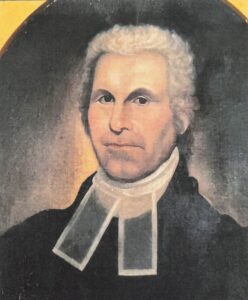
In 1747, Rhode Island settled a long-standing boundary dispute with Massachusetts for a new line of demarcation extending from Cumberland in the north to Little Compton in the south. Bristol was Rhode Island’s prize acquisition in that transaction. The former Plymouth Colony town, dating from 1680, came with two Massachusetts traditions – a town common and the Congregational Church. The latter was the established (i.e. tax supported) church in the Bay State. Rhode Island, to its credit, was the first of the 13 original colonies that declined to create an establishment of religion and the first to separate church and state.
Thirty-seven years later Massachusetts provided Bristol with another tradition when the Rev. Henry Wight (1752-1837) arrived to direct the town’s Congregational Church.
Wight was born in Medfield, Massachusetts on May 26, 1752, served in the War for Independence, graduated from Congregational-related Harvard College in 1782 with a degree in divinity, and came to Bristol on March 14, 1784. He assumed his pastoral duties on January 5, 1785 and after two decades at the church parsonage, he began residing in 1804 in a two-story house at the corner of High and Bradford Streets. The building still stands but it has been substantially altered.
Rev. Wight’s impact on Bristol was significant in many ways. He continued as sole and successful pastor of his church until 1815 when the growth of his congregation required the appointment of Rev. Joel Mann as his assistant. In that same year his oldest son, John B. Wight, was ordained as pastor of the Congregational Church in East Sudbury, Massachusetts, as a leading example of the family’s devout Christian tradition.
In 1793, Wight became a member of the Board of Fellows of Brown University, a Baptist-affiliated college, and held that position until 1833. In 1811 Brown conferred an honorary doctorate in Divinity upon Rev. Wight as evidence of his ecumenism.
Rev. Wight was an avid recordkeeper, both for his church and his town. For many years he kept a full record of current events in Bristol, particularly marriages and deaths. His book was also of great worth in proving titles to property. Wight’s long tenure – over 52 years – ended with his death on August 12, 1837 at the age of 85. He was reburied later in Juniper Hill Cemetery.
Despite his religious ministry Wight’s major contribution to his adopted state was his role as the inaugurator and perpetuator of Bristol’s nationally renowned Fourth of July Independence Observance, America’s oldest continuous observance of its kind. Wight began this now huge and momentous celebration on July 4, 1785, during the first year of his pastorate, with a stirring prayer and patriotic address in exercises held at his Congregational Church.
During the early years of the event, citizens would gather at various houses of worship to listen to the oratory of Wight and others. An 1836 newspaper story states that: “Dr. Wight gave an appropriate prayer for the 51st time at exercises held at the Congregational Church.” During the 1820s the holding of parades had made the event more public and lavish. In 1826, a “Chief Marshal of the Procession” was first designated.
A list of “Speakers of the Day” is published in the book Independence Day: How the Day is Celebrated in Bristol, Rhode Island (1989) by Richard V. Simpson the foremost historian of Bristol. He notes that Wight did not deliver the oration for all of his 52 years at the helm “but rather provided an invocation to the Patriotic Exercises” for many of those events. His last invocation was made in 1837, the year of his death. Assumedly, they were spiritual in nature.
Bristol’s famed Fourth of July Celebration has been conducted in the modern era by a large and dedicated volunteer organization of local citizens called the Bristol Fourth of July Committee. This group annually stages America’s Oldest Continuous Fourth of July Celebration in fitting tribute to its founder Rev. Henry Wight whose enduring legacy entitled him to membership in the Rhode Island Heritage Hall of Fame.
Dr. Patrick T. Conley of Bristol continued the tradition of Rev. Wight as the 2007 Patriotic Speaker. His oration, titled “Bristol Leads the Way” summarized Bristol’s leadership role in the movement to ratify the Constitution and join the Union as America’s 13th state.
Conley, president emeritus of the Rhode Island Heritage Hall of Fame (2003-2023) and a 1995 inductee, nominated Rev. Wight for membership and inducted him on July 19, 2026 as part of the 250th Anniversary observance staged by the Hall of Fame, the Heritage Harbor Foundation, and the Battle of Rhode Island Association. The date of Wight’s induction was the 250th Anniversary of Rhode Island’s ratification of the Declaration of Independence.
Dr. Patrick T. Conley
Historian Laureate of Rhode Island, Emeritus
Founding President of the Heritage Harbor Foundation