
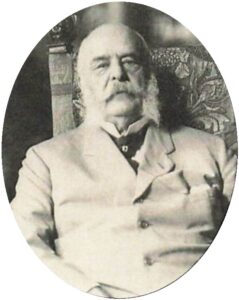
Rev. Roderick Terry was willing to use his wealth to support institutions such as the Redwood Library and Athenaeum and the Newport Historical Society. This did not simply consist of his monetary donations and gifts of hundreds of volumes of books or artifacts from around the world, but also acres of valuable land. In 1922, Terry purchased the lot adjacent to the Society to prevent its development and then gifted the property to the institution.
Beginning in 1923, Terry started buying properties that included the Revolutionary War-era Fort Butts Hill in Portsmouth and Fort Barton in Tiverton. Fort Barton was established in 1777 as a key location for a lookout over British fortifications in the northern part of Aquidneck Island during the British occupation of Newport and the rest of Aquidneck Island from December 1776 to October 1779. Fort Barton was named after William Barton, who conceived and led a 48-man party that took small boats from Warwick Neck to Middletown to seize and take prisoner British Major General Richard Prescott, then sleeping at a farmhouse at the Middletown-Portsmouth border on the West Main Road. The fort is now a protected Tiverton town park that still has some of its old earthen embankments and still has a tremendous view of Aquidneck Island to the west.
Today, Butts Hill Fort stands as the most important Revolutionary War fort in Rhode Island and probably the largest surviving fort in southern New England. At the time of its acquisition in 1923, few forts from this era remained in such good condition, and it was through Terry’s sole efforts that it began its path toward restoration.
Today, Butts Hill Fort is designated as eleven acres, divided into three separate parcels now owned by the Town of Portsmouth. It sits atop a hill approximately 200 feet high, between what are now called West Main Road and East Main Road and is circled on the north by Sprague Street. Its namesake is the John Butts family “for their loyalty and aid given to the Patriot Army during the struggle for independence.” Butts Hill Fort is the subject of an impressive restoration project through the outstanding efforts of the Battle of Rhode Island Association.
As a result of the strategic nature of the site, the Continental Army built a small battery on the hill in 1776. In December of that year, the British military occupied Aquidneck Island, and in 1777 the battery was expanded by British troops and conscripted Portsmouth residents. During the Battle of Rhode Island and in August 1778, Butts Hill Fort served as the headquarters for General John Sullivan.
On August 8, 1778, British forces evacuated Butts Hill, and the following day, American troops occupied it—a position they would hold until their successful retreat following the Battle of Rhode Island on August 29. By September, the British regained control of the site and maintained it in good condition until they departed from Rhode Island in October 1779.
The newly-arrived French military then sometimes camped there in 1780 and 1781 during their occupation of Aquidneck Island. The famous “Black Regiment” helped to build up the fort’s defenses in the second half of 1781, out of concern of a possible attack by a British force from New York (which was planned but never made). By 1782, the fort had been abandoned, and its gates and artillery platforms were sold at auction by William Anthony, appointee of the General Assembly, with the proceeds placed in the state’s treasury.
On August 29, 1923, on the 145th Anniversary of the Battle of Rhode Island, nearly 2,000 people turned out at Butts Hill to witness the reenactment and watch the dedication ceremony featuring Roderick Terry. The reenactment featured the members of the Newport Artillery Company, as well as men sent from Fort Adams and the Naval Training Station in Newport. The Providence Journal reported that during his speech, Terry declared these properties “belonged to the people of the United States.”
On April 1, 1849, Roderick was born to Elizabeth and John Terry in Brooklyn, New York. He received his early education from private tutors and graduated from Yale College in 1870. After graduation, he pursued his career as a clergyman, attending Andover Theological Seminary in Andover, Massachusetts for two years before completing his degree at Union Theological Seminary in New York City in 1875.
On September 22, 1875, Terry married Linda Marquand, the daughter of Henry G. Marquand, who had just completed the construction of his “imposing new cottage” designed by Richard Morris Hunt known as “Linden Gate” on Old Beach Road in Newport.
Roderick Terry had been summering in Newport for some time, especially during his college years at Yale. Following his retirement as a minister in Manhattan in 1904, it did not take long for Terry to relocate permanently to his beloved vacation home in Newport.
Terry quickly began to implant himself among the Newport elite and their institutions. In 1909, he read his first paper before the Newport Historical Society entitled “A Minister’s Wife in the Revolution,” marking the beginning of a long relationship with that organization. Over the course of twenty-four years, he presented nearly a dozen papers to the society.
In 1912, Terry was elected a director of the Redwood Library and appointed to the Committee on Books. The following year, he was elected Vice President. In 1914, he made his first donation of books to the library, comprising 257 volumes. Over the next twenty years, Terry donated approximately thirty volumes to the library each year. In 1916, Terry was elected President of the Redwood Library “for his services and the thought, time, and money he has continuously contributed.” In 1931, he financed the restoration of the Reading Room.
Both Terry and the president before him, Daniel Fearing, were known to have a “lively interest” in Native American artifacts and history. To raise membership totals for the historical society, Terry and Fearing held an Indian Exhibition, which attracted widespread attention and was the immediate cause of a marked increase in membership. In the preserved program for the event (held July 18, 1914, at the home of banker Lawrence Gillespie), Terry is listed as the “Senior Officer” of the Historical Society tasked with its organization. He was assisted by Gillespie’s wife, Irene, and Ellen Vanderbilt, the former wife of Alfred Vanderbilt. Roderick’s wife is also listed as a “Patroness.” This lawn party fundraiser featured songs, dances, silhouette cuttings, and palm readings.
Terry’s fascination with Native American artifacts did not cease after the 1914 event. The Newport Historical Society began to collect artifacts of Indigenous peoples, both locally and throughout the United States. According to Lloyd Mayer, the Society Librarian, Terry “secured for the society a truly remarkable Indian collection housed in a separate room,” which consisted “largely of specimens gathered from Newport County sites of Indian activity.” This separate room was known as the Indian Room, and a system of notecards was created to catalog the items in the collection. As a result of neglect and theft, many of the artifacts are now missing. However, the notecards remain in the society’s archive. They encompass a diverse range of locations, extending beyond the Indigenous peoples of Newport County.
Terry also renovated the Redwood Library’s exterior. At his behest alone, the owner of the Redwood Farm Garden House, Bradford Norman, moved the house from his property in Portsmouth to the library grounds in 1917, where it remains today. A stone’s throw from the Garden House stands a statue of George Washington, crafted from a bust created by the renowned French artist Jean-Antoine Houdon. Terry also financed it and its installation at the library in 1932. In 1928, Terry funded the pyramid-like monument at the location in King’s Park where the Comte de Rochambeau landed with the French forces in 1780.
Terry not only acquired a large collection of books over the years, he was also a prolific autograph collector. His collection included signatures of George Washington, General Nathanael Greene, and “a complete set of the autographs of the Signers of the Declaration of Independence,” which included rare signatures of Button Gwinnett of Georgia and Thomas Lynch Jr. of South Carolina. The collection included autographs from notable figures such as authors Charlotte Brontë, Lord Byron, and Edgar Allan Poe, as well as astronomer Galileo Galilei, and monarchs including Queen Elizabeth I of England and Mary, Queen of Scots. Additionally, more than a dozen other autographs are housed in the Roderick Terry Papers at the Newport Historical Society archive. These signatures include Otto von Bismarck, Chancellor of Germany, and Gabriele D’Annunzio, an Italian nationalist who inspired Benito Mussolini.
Terry was not simply a collector of books and autographs, he was also an author. He wrote multiple papers to present before the Newport Historical Society and to be published in their journal. Following the reading of his first paper before the society in 1909, Terry developed a lasting relationship with the Newport Historical Society, which continued until he died in 1933. The Bulletin of the Newport Historical Society, the official publication of the society that Terry himself founded, dedicated an entire issue to him in 1934.
Roderick and Linda had two children, Roderick Jr. a lawyer who also served as president of the Redwood Library from 1940 to 1948 and Eunice who married into the politically prominent Hale family of Maine.
Rev. Roderick Terry died on December 28, 1933 and was buried in Newport’s Island Cemetery. He was inducted into the Rhode Island Heritage Hall of Fame on July 19, 2026 on Butts Hill.
Kenneth R. Dooley
Rhode Island Heritage Hall of Fame inductee and director emeritus