
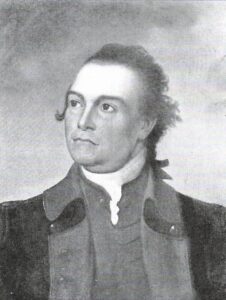
John Sullivan (1740-1795) was born in Somersworth, New Hampshire, the third son of Irish settlers from County Cork who, as Catholics, fled Ireland because of the English Penal Laws.
After studying law as a teenager, Sullivan began its practice in 1763. Because of his increasing professional prominence and his opposition to British policies, he became one of New Hampshire’s two delegates to the First Continental Congress in 1774. In December 1774, copying the example set in Newport, Rhode Island, Sullivan led an attack by Patriots on Fort William and Mary at Portsmouth, New Hampshire. He removed cannon from the fort to avoid the cannon being taken away by the Royal Navy. The Second Congress appointed him to the rank of brigadier general based upon his service in the rebel New Hampshire militia.
After General Washington placed Sullivan in joint command of American troops on Long Island, he was captured during the Battle of Long Island in August 1776 despite his personal heroism. He was later released in a prisoner exchange for captured British General Richard Prescott who would be seized again in July, 1777 by Colonel William Barton in a daring raid on a farmhouse located at the town line between Middletown and Portsmouth, Rhode Island.
Sullivan rejoined Washington before the Battle of Trenton in December 1776 and crossed the Delaware with him to defeat the Hessian forces. Sullivan led one of the columns marching in the driving snow that reached Trenton. In January, 1777 he fought well in the Battle of Princeton and then campaigned in Pennsylvania for the duration of the year.
In April 1778 Washington assigned Sullivan to direct the military affairs of Rhode Island from headquarters in Providence. Washington anticipated a siege of the British army that had occupied Newport since December 1776. Sullivan’s almost one-year tenure in Rhode Island highlighted by his victory in the August 29, 1778 Battle of Rhode Island (or the Battle of Butts Hill) have earned him induction into the Rhode Island Heritage Hall of Fame. Like the Hall of Fame explorer Giovanni da Verrazzano, his stay was brief, but momentous.
The military and naval engagements Sullivan and others launched to liberate Newport can best be described as the Rhode Island Campaign. This project, that consisted of land and sea maneuvers, commenced on July 28, 1778, with the arrival of Count d’Estaing’s French fleet off Block Island and concluded with the arrival of a British relief force in Newport under Sir Henry Clinton on September 1, 1778. News of the departure from New York of that fleet, with its complement of 4,000 troops, prompted the Americans to end their campaign (then in Middletown) to expel the British from Newport. A masterful analysis of this oft-neglected episode in the War for Independence appears in the books The Rhode Island Campaign, by Christian McBurney (2011) and the late Paul F. Dearden’s The Rhode Island Campaign of 1778: Inauspicious Dawn of Alliance (1980) whose intricate detail need not be repeated here.
The Rhode Island Campaign to dislodge the British from Newport was not the same as the Battle of Rhode Island. The campaign was of five weeks duration and involved troop movements and naval actions throughout Aquidneck Island and the lower bay and a running fight between the English and French fleets in the Atlantic Ocean many miles to the south of Block Island. The battle was a one-day encounter that occurred on August 29, 1778 in the town of Portsmouth as British forces, many of whom were Germans from Hesse and Anspach, advanced north from fortified Newport in an attempt to turn the American evacuation of Aquidneck into a rout. Had the clash on August 29 been called the Battle of Portsmouth or the Battle of Butts Hill, its independent significance would be more obvious and more appreciated.
The catalyst for the crucial one-day battle was the withdrawal of American troops from the siege trenches around Newport prompted by news of British reinforcements by sea. As the siege lifted and Americans moved northward on Aquidneck to evacuate the island, British and Hessian soldiers followed in an attempt to overrun and capture Sullivan’s army. To prevent this disaster the Americans halted to confront and beat back the pursuing enemy so as to safeguard evacuation. Sullivan made his stand on Butts Hill in Portsmouth.
Here Americans fought the largest land battle in New England history. On that fateful August 29, 1778, over 10,000 troops and four ships clashed in Portsmouth in a 13-hour contest that prevented the British and Hessians from disrupting the evacuation of a 5,000-man American army from Aquidneck Island after its unsuccessful siege of Newport.
Led by New Hampshire General John Sullivan and such Rhode Island military stalwarts as Nathanael Greene, James Mitchell Varnum, Christopher Greene, Silas Talbot, Israel Angell, and Samuel Ward, Jr., then serving as the commander of the famed “Black Regiment,” the Americans decisively repulsed repeated British assaults against their line centered on Butts Hill in northern Portsmouth. The Patriots held that line, fending off an attack by British troops on the East Road and three attacks by German and Loyalist regular troops on the West Road. The Black Regiment, consisting mostly of formerly enslaved men of color who had gained their freedom by enlisting in the regiment, made its famous stand on the West Road.
Sullivan had wisely posted advance American units at the approaches on the East and West roads. These advanced troops helped to blunt and tire the attackers. The advanced troops actually had a successful ambush on a British regiment at Union Street near what is now the Portsmouth Historical Society and made a temporarily successful counterattack at Quaker Hill. Sullivan, however, wisely had the advance units retreat back to the main lines buttressed by Fort Butts Hill. Despite General Greene’s urging, Sullivan refused to fight a larger “general engagement”; rather, Sullivan’s goal was simply to get his army safely off of Aquidneck Island.
During the Battle of Rhode Island, the British suffered one of their highest casualty-counts of the war — 38 killed and 210 wounded. Not only was the encounter very high on the British casualty list, the 30 Americans killed and 137 wounded also placed it 17th among the 1,331 wartime engagements.
Late in the following evening and into the early morning Sullivan proceeded with the evacuation of his army. The crossings to Tiverton and Bristol were on small boats mostly manned by Rhode Island militia with experience as boatmen. The withdrawal of about 5,000 troops and equipment was aided by farmers from as far north as Taunton who furnished large numbers of wagons and draft animals to facilitate the exodus of Sullivan’s sizeable force. The Marquis de Lafayette, arriving too late from Boston to participate in the battle, assisted in the evacuation. (He reportedly called the Battle of Rhode Island one of the best fought actions of the war, a testament to Sullivan’s performance.) Sullivan reported to Congress that “not a man was left behind, nor the smallest article lost.” This feat was an American Dunkirk!
In March, 1779, General Sullivan moved from the ocean to the wilds of central New York where he conducted a brutal, scorched-earth campaign against the Iroquois nation’s fierce warriors who were allies of the English.
After returning to New Hampshire in 1780, Sullivan served in Congress, became attorney general, and then governor of the state (1786-89). His brother James matched that feat becoming governor of Massachusetts in 1807. General Sullivan received an appointment from his old commander, President Washington, as the U.S. judge for the District of New Hampshire in 1789 after leading the campaign for New Hampshire’s ratification of the Constitution on June 21, 1788. He died in office on January 23, 1795 at the age of 54.
General Sullivan was inducted into the Rhode Island Heritage Hall of Fame on Butts Hill, at the site of his main defensive post, on July 19, 2026, Rhode Island Independence Day.
For further reading:
Karl F. Stephens, Neither the Charm Nor the Luck: Major General John Sullivan (2009)
Charles P. Whittemore, A General of the Revolution: John Sullivan of New Hampshire (1961)
Patrick T. Conley, J.D., Ph.D.
Historian Laureate of Rhode Island
Emeritus and Former Chairman of the Rhode Island Bicentennial Commission (ri 76)
Christian McBurney, Esquire
Historian, lecturer, and founding editor of Small State Big History website.