
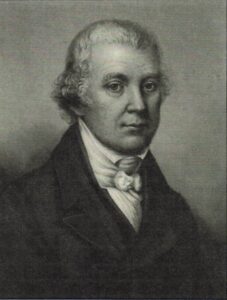
Governor Samuel Ward’s second son, Samuel Jr. (“Sammy”) was born November 17, 1756 in Westerly. He graduated from Rhode Island College (Brown University) in 1771 at the age of fifteen. His military career began when he was commissioned a captain in the Rhode Island Army of Observation in May, 1775, at the age of eighteen. He participated in Benedict Arnold’s failed attack on Quebec in December, 1775, under the command of his brother-in-law, Lieutenant-Colonel Christopher Greene (husband of his sister Catherine), and was taken prisoner by the British. He was released in August, 1776.
Subsequently, Ward was promoted to the rank of major in the First Rhode Island Regiment of Continentals and, between 1776 and 1778, served with his regiment at Morristown, New Jersey (1777); Peekskill, New York (1777); Red Bank, New Jersey (Fort Mercer) under Colonel Christopher Greene (1777); Valley Forge (1778); and, most prominently, in the Battle of Rhode Island (1778).
In 1777, Ward helped Colonel Christopher Greene and the two Rhode Island Continental regiments under his command successfully defend Fort Mercer against a German force three times the size of the defenders. It was one of the most stunning American victories of the war. Ward sent the first detailed letter of the victory at Red Bank to Washington. Ward wrote that Colonel Greene wanted the commander-in-chief to know that “both officers and private men behaved with the greatest bravery.”
Ward married Phebe Greene in 1778 while on leave from his military duties at Valley Forge. She was the daughter of Governor William Greene and Catherine (Ray), who was a member of a prominent Block Island family.
In January 1778, at Valley Forge, Ward joined with Colonel Greene and Brigadier General James Varnum in arriving at a plan to re-establish the First and Second Rhode Island Regiments of Continentals, which plan was approved by General Washington and the Rhode Island General Assembly. The White soldiers of the First Rhode Island were transferred to the Second Rhode Island, and the free privates of color (including Native and African-American men) in the Second Rhode Island were transferred to the First Rhode Island. Enslaved Rhode Islanders were offered the ability to enlist in the First Rhode Island and obtain their freedom, with no exceptions.
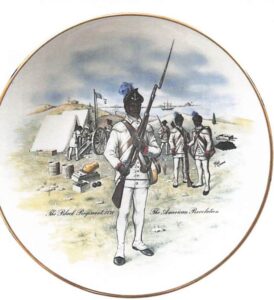
Later in January, Ward and Greene returned to Rhode Island to recruit enslaved men to join the First Rhode Island. More than 130 did so, forming the core of what would be called the “Black Regiment” that would play an instrumental role in the military action on August 29, 1778, properly known as the Battle of Rhode Island. In this clash, the British and Hessians were beaten back in their attempt to overrun the American forces who were withdrawing from Aquidneck Island after the unsuccessful siege of Newport.
At the siege of Newport and the Battle of Rhode Island, because Colonel Greene commanded a brigade in General John Sullivan’s American army, Ward took command of the “Black Regiment.” The regiment then consisted of about 175 privates and musicians of color who were present and fit for duty (its officers, sergeants and corporals were all White men). Ward wrote to his wife Phebe, on August 23, 1778, when the regiment was stationed on Aquidneck Island during the Rhode Island Campaign, “my lads . . . have a great place of respect as Soldiers.” During the Battle of Rhode Island, the regiment was stationed near a redoubt that anchored the extreme right (west) wing of General Sullivan’s defensive line and helped to beat back three vigorous charges from trained Hessian mercenary soldiers. The general ability of American troops to hold their line on that hot August day allowed Sullivan’s entire army to be evacuated safely and without capture in what has later been described as an “American Dunkirk.”
In May, 1779, Ward was promoted to Lieutenant-Colonel of the First Rhode Island Regiment. The regiment remained in Rhode Island, patrolling the mainland so long as a British army remained in Newport. In October, 1779 the British evacuated Newport and the First Rhode Island entered the town and remained for the winter. When the French allies arrived in July, 1780 to occupy Newport, the First Rhode Island was often the only Continental army regiment in the theater.
In early 1781, Congress ordered the First Rhode Island to merge with the Second Rhode Island, and several officers, including Ward, were forced to retire. In a letter dated April 16, 1781 Christopher Greene told Ward “I often very agreeably reflect upon the Toils and Dangers we have gone through together during the Course of this horrid War and nothing could have been more agreeable than to have had your company in command to the end of it, but so it could not be . . . we therefore must for the present be apart.”
After the war Ward went into business as a merchant in Warwick where he remained until about 1787. During 1788 and 1789, Ward sailed to China for the Providence firm Brown & Francis as supercargo for the vessel General Washington, the first Rhode Island ship to engage in the China trade that soon became a staple of the state’s economy.
Ward moved to New York in late 1790, to engage in business with his brothers Richard and John under the firm named Samuel Ward and Brothers. Ward returned to Rhode Island in 1804; then went back to New York in 1807, though his wife Phoebe remained in Rhode Island.
Samuel was president of the New York Marine Insurance Company until about 1808. He returned to Rhode Island in 1809 and stayed until about 1816, then made his permanent home in New York: first in Jamaica, Long Island, then in New York City, where he died in 1832.
Samuel and Phoebe Ward had eight children. Their third son Samuel III, a New York banker, became the father of Julia (Ward) Howe (1819-1910), the abolitionist and author of Battle Hymn of the Republic. In the post-war years, Howe was a women’s rights advocate, spending most of her summers on Aquidneck Island. She has been inducted into the Rhode Island Heritage Hall of Fame.
Colonel Samuel joined his father, Governor Samuel Ward, and his illustrious granddaughter Julia with his own Hall of Fame induction on July 19, 2026 at Butts Hill.
Patrick T. Conley
Historian Laureate of Rhode Island
Emeritus and Chairman of the Rhode Island Bicentennial Commission (ri 76)
Christian McBurney, Esquire
Historian, Lecturer and founding editor of the Small State Big History website.