
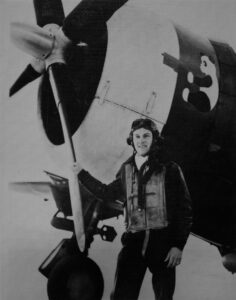
George L. Sutcliffe was a WWII flying ace whose heroic exploits as a fighter pilot have been chronicled in several books and films. He flew eighty missions and earned numerous decorations. He enlisted in the Army Air Forces shortly after Pearl Harbor and was deployed to Europe with the 368th Fighter Group. He flew four support missions on June 6, 1944, D-Day, over Normandy. He received worldwide fame when, on June 14, 1944, he successfully outmaneuvered 40 enemy warplanes in an intense air battle over Lisieux, France.
Lt. Sutcliffe was deployed to Europe in December 1943, where he flew P-47 fighter-bombers, “Thunderbolts”. He flew on D-Day to escort bombers, drop his own, and strafe ground targets. “We had at least two 500-pound bombs under the wing,” Sutcliffe says, “and depending on the target we’d have a 1,000-pound bomb under the wings. And we’d dive bomb railroad yards, airports, bridges. We were trying to knock out areas that could benefit the Germans.”
Sutcliffe says it was scary work at times. “We had to fly so low all the time; they were throwing everything at us. The small-arms German fire was very good, and so were the 20-millimeter guns they had. And, of course, we got into an area where they had a lot of men, soldiers; we’d get shot up with the machine guns, even rifles. We lost a lot of guys.”
Sutcliffe recounted his mission when he fought an air battle against 40 German fighters on June 14th, 1944. “It was a flight of four. That’s your basic fighting formation, four aircraft. We had dropped our bombs on a certain target, and then we were heading back to England, looking for targets of opportunity.” Sutcliffe’s squadron was flying low, at 2,000 feet, right under a cloud layer. About 30 to 40 enemy aircraft came out of the clouds and lined up behind us. They were Messerschmitt 109’s — fast, maneuverable, some of the best-built fighters the Luftwaffe put in the air. And at this moment they were there in force. As soon as I saw them, I called the squadron commander, and I’m hollering, ‘Colonel, break left, break left!’ ” Sutcliffe said. “As soon as he made the turn, he looked at the number of aircraft coming at us, he said, ‘Let’s get the hell out of here; there are too many.’ ” And that’s what two of the American pilots did: They pulled safely into the clouds. Another was shot down, so that left Sutcliffe.
“I tried to reach the clouds, but I couldn’t,” Sutcliffe recalled. “I pulled the nose up and went as fast as I could, but when the nose gets too high, the plane loses lift and nearly stalls—you’re just hanging there. They came at me from both sides, firing and punching holes in my plane.” Tracer fire streaked past his cockpit, and a 20-millimeter cannon shell tore through the rear of the aircraft, stopping only at the armor plate behind his head.
For 15 full minutes — an eternity in a dogfight — the way-outnumbered Sutcliffe pushed that P-47. He did corkscrews, dove for the ground, then headed for cloud cover, only to find the 109s blocking him. He dove again. At one moment, he was flying at 500 miles per hour in a plane rated to top out at 450. In all that maneuvering, he shot down a 109 before finally reaching the clouds safely.
“I felt like I maybe had a little help from above on that day,” he says. “There was really no reason I should’ve got out of there.”
Sutcliffe made an emergency landing on D-Day at Omaha Beach to get his plane patched up and refueled so he could make it over the English Channel. When he returned to base, Sutcliffe found his squadron mates thought he hadn’t made it out. “I went back to my barracks, and two guys were trying my clothes on.”
His heroic actions led to his induction into the Smithfield Heritage Hall of Fame, State of Rhode Island Heritage Hall of Fame, and the State of Rhode Island Aviation Hall of Fame. George also appeared in History Channel’s documentary series “Dogfights.” He also became a member of the Caterpillar Club for bailing out of his airplane over New Haven, CT, in 1943. After more than 80 combat missions, he was awarded the Silver Star and Distinguished Flying Cross.
George was born in North Providence on February 7, 1923, son of George W. and Gladys (Warburton) Sutcliffe. After the war, George attended Bryant on the G.I. Bill and received his Bachelor of Science in Accounting. George established the successful Bradford-Sutcliffe Insurance Agency in 1957 and the Jay G. Lawrence Foundation in 2001. He was also a past president of the Smithfield Lions Club and a member of the Quiet Birdmen Pilot Association, the Smithfield Memorial Veterans Committee, the Quonset Air Museum, Smithfield VFW #2929, and the National World War II Museum. More than anything, he was a true humanitarian and always lent a helping hand to those less fortunate.
At 86, Sutcliffe climbed into the cockpit of a restored P-51 fighter on a tarmac in Norwood, Massachusetts. The aircraft resembled the Thunderbolt he had flown in combat. Taking the controls, he flew it to the next stop on the tour. Although his eyesight had weakened and his reflexes had slowed, he still rolled the plane over the field a few times—this time purely for show.
George Sutcliffe died on June 20, 2011, leaving his wife, Olive, and his children, Lynne and Barry.