
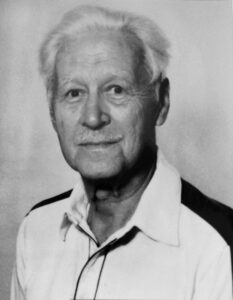
Domina “Dom” C. Jalbert was an early parachuting pioneer who greatly advanced the sport of skydiving. He did extensive work on kites, balloons, and canopies, earning many patents. For the skydiving community, his greatest contribution was the multi-celled canopy, which he patented in 1963. In 1964, he patented the Multi-cell Wing Type Aerial device, known to skydivers as the Parafoil. From that point forward, (multi-cell) ram-air type parachutes revolutionized and popularized the sport of skydiving.
Domina Jalbert was born in 1904 in Saint-Michel-des-Saints, Quebec, Canada; his father was Onesime Jalbert, and his mother was Celestine Gouger. He was one of 17 children. Early in his life, he moved to Woonsocket, Rhode Island, where he lived and worked for many years. While living in Woonsocket, Jalbert graduated from Woonsocket High School and later worked as a track coach and administrator for Mount St. Charles Academy.
Jalbert received a U.S. pilot’s license in 1927. In the 1930s, he was active in kiting, using large kites for advertising purposes. He was hired to help protect the coastline of the western United States during World War II by designing and making barrage balloons. After the war, he worked for the United States Rubber Company in Naugatuck, Connecticut, and Providence, Rhode Island.
In 1942, Jalbert demonstrated the power of his custom-made kite by lifting his daughter, Dorothy Jalbert, in a “kite-swing” at Point Judith, Rhode Island. He filed a patent in 1944 for a combination of a balloon with a stiffened flexible wing, forming what is now known as a “kytoon.” In 1956, Jalbert successfully tested his square parachute for the first time in Boca Raton, Florida.
In 1957, Jalbert invented the ram-air airfoil and began testing and formalizing the design. In January 1963, he formally confirmed his discovery and invention of the ram-air double-surfaced fully flexible airfoil that would profoundly change kiting, parachuting, skydiving, hang gliding, paragliding, sport flying, power kiting, and more. All parafoils today owe their roots to Jalbert’s invention.
In 1964, he filed a patent titled “Multi-cell Wing Type Aerial Device.” This would become key to paragliding, skydiving, powered paragliding, land boarding, kite surfing, and cargo-ship kite tugging. In 1971, Jalbert’s dream of creating a ram-air parachute became a reality. Working with Jalbert, Theodore Hulsizer, a civilian prototype parachute manufacturer for the United States Air Force and NASA, made the first parafoil parachute that worked. While testing his prototype in the wind tunnel at Wright-Patterson Air Force Base in Dayton, Ohio, Theodore realized its drag was far greater than any other parachute he had tested in his 25 years of experience. He believed others’ attempts ripped to shreds because of the drag. To slow the parafoil’s opening, Jalbert ran the cords through rings he designed and slid to the top while packing the parachute. As it opened, the rings slid down, slowing the opening. These rings later evolved to be the slider in modern ram-air parachutes. Jalbert personally made the first full-size parafoil, which worked perfectly in its first drop.
Jalbert received the following patents for his revolutionary designs:
- Kite Balloon. Filing date: April 15, 1944
- Multi-Cell Glide Canopy Parachute D. C. Jalbert
- Multi-Cell Wing Type Aerial Device Filing date: October 1, 1964
- Aerial sled
In 1996, he received an award from the Parachute Industry Association for his many accomplishments in parachute design. He was inducted into the Rhode Island Heritage Hall of Fame in 1988. In 2019, the Fédération Aéronautique Internationale (World Air Sports Federation) posthumously awarded Jalbert the FAI Gold Air Medal for inventing the multi-cell ram-air wing. In 1984, at the age of 79, Jalbert traveled to Beijing, China, to demonstrate his parafoils.
Jalbert married champion swimmer Elizabeth Becker in 1933, and they had one daughter, Dorothy Christina Jalbert. After Elizabeth died, he married Emma Rose Bourcier on October 28, 1943, in Providence, Rhode Island. The couple moved to Belmont, Massachusetts, and lived there in 1945. They had one son, Paul Charles Jalbert.
Jalbert died on June 26, 1991, in Boca Raton, Florida.